33 Quotes from 21 Lessons for the 21st Century book by Yuval Noah Harari
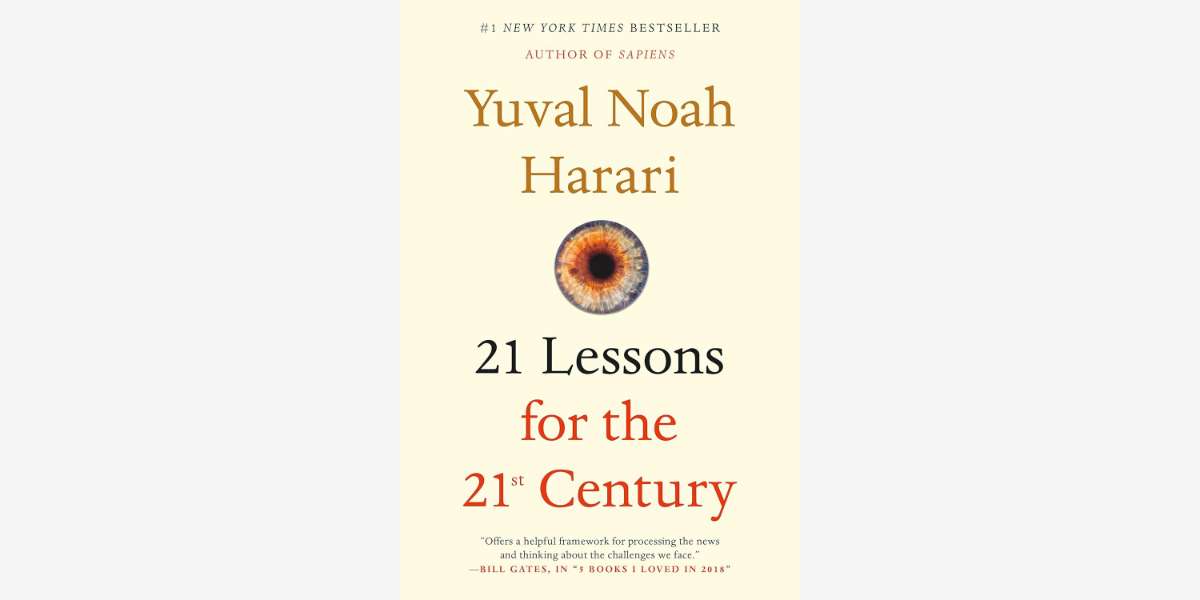
Hello and Welcome. This page is a collection of 33 quotes from 21 Lessons for the 21st Century book by Yuval Noah Harari that I underlined while reading the book. I hope you will like these quotes too.
By the way, I am Deepak Kundu, an avid book reader, quotes collector and blogger.
Quotes on Terrorism
- Terrorists are masters of mind control. They kill very few people, but nevertheless manage to terrify billions and shake huge political structures such as the European Union or the United States.
- The terrorists hope that even though they can barely dent the enemy's material power, fear and confusion will cause the enemy to misuse his intact strength and overreact. Terrorists calculate that when the enraged enemy uses his massive power against them, he will raise a much more violent military and political storm than the terrorists themselves could ever create. During every storm, many unforeseen things happen. Mistakes are made, atrocities are committed, public opinion wavers, neutrals change their stance, and the balance of power shifts.
- A terrorist is like a gambler holding a particularly bad hand, who tries to convince his rivals to reshuffle the cards. He cannot lose anything, and he may win everything.
- Terrorism is a military strategy that hopes to change the political situation by spreading fear rather than by causing material damage. This strategy is almost always adopted by very weak parties who cannot inflict much material damage on their enemies. [...] In terrorism, fear is the main story, and there is an astounding disproportion between the actual strength of the terrorists and the fear they manage to inspire.
- Terrorists resemble a fly that tries to destroy a china shop. The fly is so weak that it cannot move even a single teacup. So how does a fly destroy a china shop? It finds a bull, gets inside its ear, and starts buzzing. The bull goes wild with fear and anger, and destroys the china shop. This is what happened after 9/11, as Islamic fundamentalists incited the American bull to destroy the Middle Eastern china shop. Now they flourish in the wreckage. And there is no shortage of short-tempered bulls in the world.
- Terrorists undertake an impossible mission: to change the political balance of power through violence, despite having no army. To achieve their aim, terrorists present the state with an impossible challenge of their own: to prove that it can protect all its citizens from political violence, anywhere, any time. The terrorists hope that when the state tries to fulfil this impossible mission, it will reshuffle the political cards, and hand them some unforeseen ace.
Quotes on Democracy
- In the late twentieth century democracies usually outperformed dictatorships because democracies were better at data-processing. Democracy diffuses the power to process information and make decisions among many people and institutions, whereas dictatorship concentrates information and power in one place. Given twentieth-century technology, it was inefficient to concentrate too much information and power in one place. [...] However, soon AI might swing the pendulum in the opposite direction. AI makes it possible to process enormous amounts of information centrally. Indeed, AI might make centralised systems far more efficient than diffused systems, because machine learning works better the more information it can analyse.
- Referendums and elections are always about human feelings, not about human rationality. If democracy were a matter of rational decision-making, there would be absolutely no reason to give all people equal voting rights - or perhaps any voting rights.
Quotes on Religion
- Many religions praise the value of humility - but then imagine themselves to be the most important thing in the universe. They mix calls for personal meekness with blatant collective arrogance. Humans of all creeds would do well to take humility more seriously.
- When a thousand people believe some made-up story for one month - that's fake news. When a billion people believe it for a thousand years - that's a religion.
Quotes on Stupidity
- Human stupidity is one of the most important forces in history, yet we often discount it. Politicians, generals and scholars treat the world as a great chess game, where every move follows careful rational calculations. This is correct up to a point. Few leaders in history have been mad in the narrow sense of the word, moving pawns and knights at random. [...] The problem is that the world is far more complicated than a chessboard, and human rationality is not up to the task of really understanding it. Hence even rational leaders frequently end up doing very stupid things.
- We should never underestimate human stupidity. Both on the personal and on the collective level, humans are prone to engage in self-destructive activities.
Quotes on Technology
- Humans could never predict the future with accuracy. But today it is more difficult than ever before, because once technology enables us to engineer bodies, brains and minds, we can no longer be certain about anything - including things that previously seemed fixed and eternal.
- Technology isn't bad. If you know what you want in life, technology can help you get it. But if you don't know what you want in life, it will be all too easy for technology to shape your aims for you and take control of your life. Especially as technology gets better at understanding humans, you might increasingly find yourself serving it, instead of it serving you. Have you seen those zombies who roam the streets with their faces glued to their smartphones? Do you think they control the technology, or does the technology control them?
More Quotes
- There are many things that governments, corporations and individuals can do to avoid climate change. But to be effective, they must be done on a global level. When it comes to climate, countries are just not sovereign. They are at the mercy of actions taken by people on the other side of the planet.
- In previous centuries national identities were forged because humans faced problems and opportunities that were far beyond the scope of local tribes, and that only countrywide cooperation could hope to handle. In the twenty-first century, nations find themselves in the same situation as the old tribes: they are no longer the right framework to manage the most important challenges of the age. We need a new global identity because national institutions are incapable of handling a set of unprecedented global predicaments. We now have a global ecology, a global economy and a global science - but we are still stuck with only national politics.
- An atom bomb is such an obvious and immediate threat that nobody can ignore it. Global warming, in contrast, is a more vague and protracted menace. Hence whenever long-term environmental considerations demand some painful short-term sacrifice, nationalists might be tempted to put immediate national interests first, and reassure themselves that they can worry about the environment later, or just leave it to people elsewhere. Alternatively, they may simply deny the problem. It isn't a coincidence that scepticism about climate change tends to be the preserve of the nationalist right.
- A society of courageous people willing to admit ignorance and raise difficult questions is usually not just more prosperous but also more peaceful than societies in which everyone must unquestioningly accept a single answer. People afraid of losing their truth tend to be more violent than people who are used to looking at the world from several different viewpoints. Questions you cannot answer are usually far better for you than answers you cannot question.
- Humans rarely think for themselves. Rather, we think in groups. Just as it takes a tribe to raise a child, it also takes a tribe to invent a tool, solve a conflict, or cure a disease. No individual knows everything it takes to build a cathedral, an atom bomb, or an aircraft. What gave Homo sapiens an edge over all other animals and turned us into the masters of the planet was not our individual rationality, but our unparalleled ability to think together in large groups.
- Revolution isn't a picnic, and if you want an omelette you need to break a few eggs.
- If you want to go deeply into any subject, you need a lot of time, and in particular you need the privilege of wasting time. You need to experiment with unproductive paths, to explore dead ends, to make space for doubts and boredom, and to allow little seeds of insight to slowly grow and blossom. If you cannot afford to waste time - you will never find the truth.
- The real enigma of life is not what happens after you die, but what happens before you die. If you want to understand death, you need to understand life.
- Astronauts devote many years to difficult training regimes, preparing for their hazardous excursions to outer space. If we are willing to make such efforts in order to understand foreign cultures, unknown species and distant planets, it might be worth working just as hard in order to understand our own minds. And we had better understand our minds before the algorithms make our minds up for us.
- We are now creating tame humans that produce enormous amounts of data and function as very efficient chips in a huge data-processing mechanism, but these data-cows hardly maximise the human potential. Indeed we have no idea what the full human potential is, because we know so little about the human mind. And yet we hardly invest much in exploring the human mind, and instead focus on increasing the speed of our Internet connections and the efficiency of our Big Data algorithms. If we are not careful, we will end up with downgraded humans misusing upgraded computers to wreak havoc on themselves and on the world.
- As a species, humans prefer power to truth. We spend far more time and effort on trying to control the world than on trying to understand it - and even when we try to understand it, we usually do so in the hope that understanding the world will make it easier to control it. Therefore, if you dream of a society in which truth reigns supreme and myths are ignored, you have little to expect from Homo sapiens. Better try your luck with chimps.
- If you ask for the true meaning of life and get a story in reply, know that this is the wrong answer. The exact details don't really matter. Any story is wrong, simply for being a story. The universe just does not work like a story.
- In order to cope with the unprecedented technological and economic disruptions of the twenty-first century, we need to develop new social and economic models as soon as possible. These models should be guided by the principle of protecting humans rather than jobs. Many jobs are uninspiring drudgery, not worth saving. Nobody's life-dream is to be a cashier.
- War spreads ideas, technologies and people far more quickly than commerce. [...] War also makes people far more interested in one another. [...] People care far more about their enemies than about their trade partners. For every American film about Taiwan, there are probably fifty about Vietnam.
- For thousands of years philosophers and prophets have urged people to know themselves. But this advice was never more urgent than in the twenty-first century, because unlike in the days of Laozi or Socrates, now you have serious competition. Coca-Cola, Amazon, Baidu and the government are all racing to hack you. Not your smartphone, not your computer, and not your bank account - they are in a race to hack you and your organic operating system. You might have heard that we are living in the era of hacking computers, but that's hardly half the truth. In fact, we are living in the era of hacking humans.
- When the biotech revolution merges with the infotech revolution, it will produce Big Data algorithms that can monitor and understand my feelings much better than I can, and then authority will probably shift from humans to computers. My illusion of free will is likely to disintegrate as I daily encounter institutions, corporations and government agencies that understand and manipulate what was hitherto my inaccessible inner realm.
- If we invest too much in developing AI and too little in developing human consciousness, the very sophisticated artificial intelligence of computers might only serve to empower the natural stupidity of humans. We are unlikely to face a robot rebellion in the coming decades, but we might have to deal with hordes of bots who know how to press our emotional buttons better than our mother, and use this uncanny ability to try and sell us something - be it a car, a politician, or an entire ideology.
- In ancient times land was the most important asset in the world, politics was a struggle to control land, and if too much land became concentrated in too few hands - society split into aristocrats and commoners. In the modern era machines and factories became more important than land, and political struggles focused on controlling these vital means of production. If too many of the machines became concentrated in too few hands - society split into capitalists and proletarians. In the twenty-first century, however, data will eclipse both land and machinery as the most important asset, and politics will be a struggle to control the flow of data.
- At present, people are happy to give away their most valuable asset - their personal data - in exchange for free email services and funny cat videos. It is a bit like African and Native American tribes who unwittingly sold entire countries to European imperialists in exchange for colourful beads and cheap trinkets. If, later on, ordinary people decide to try and block the flow of data, they might find it increasingly difficult, especially as they might come to rely on the network for all their decisions, and even for their healthcare and physical survival.